
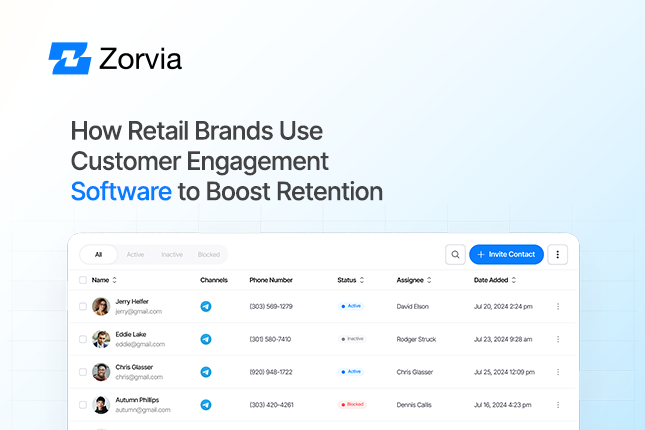

Here’s a number that should keep every retail marketer up at night: according to Harvard Business Review, acquiring a new customer costs anywhere from 5 to 25 times more than retaining an existing one. Yet most reHow Retail Brands Use Customer Engagement Software to Boost Customer Retention
Getting a customer to buy once is only the beginning.
The bigger challenge is getting them to come back.
For retail businesses, that relationship often lives inside everyday conversations. A customer asks about a product on Instagram. They move to WhatsApp to place an order. They follow up later with a question. Another customer sends a Telegram message while your team is already handling dozens of other conversations.
When those conversations are scattered across different platforms, customers can easily get missed.
And when messages get missed, sales get missed too.
That is why customer retention is not only a marketing problem. It is also a customer communication problem.
The brands that retain customers well are usually the ones that make it easy to ask questions, get help, complete a purchase, and continue the relationship after the sale.
Customer engagement software can help make that possible by bringing conversations into one place, helping teams respond faster, and giving businesses a better way to manage customer relationships as they grow.
For retail businesses operating through WhatsApp, Instagram, Telegram, and other social channels, this becomes even more important.
What Is Customer Engagement Software?
Customer engagement software helps businesses manage conversations and interactions with customers across the channels they already use.
Instead of asking a team to manage each platform separately, the right platform brings important conversations together so the business can respond from one place.
For a retail business, that can mean:
- Managing customer conversations from multiple channels
- Keeping conversations organised in one shared inbox
- Helping team members work together on customer enquiries
- Making sure important messages are not buried or forgotten
- Giving business owners greater visibility and control over customer relationships
- Making it easier to delegate customer service without giving away ownership of the relationship
This is especially useful for businesses that have moved beyond one person handling every customer conversation.
As the team grows, communication becomes harder to manage manually.
The challenge is no longer simply answering customers.
It is answering them consistently, quickly, and without losing control of the relationships that drive the business.
Why Customer Engagement Matters for Retail Retention
A customer does not become loyal simply because they bought something.
They become loyal because the business consistently gives them reasons to return.
That can happen through a good product, but it can also happen through the experience around the product.
A customer who gets a quick answer when they have a question is more likely to trust the business.
A customer whose previous conversation is easy for the team to understand does not have to start over.
A customer who can reach the business through the channel they already use does not have to change their behaviour just to get support.
And a customer who receives consistent service from different members of the team is more likely to feel that the business is organised and reliable.
This is why Zorvia’s brand framework focuses on a simple outcome:
Nothing gets missed.
The framework describes the value of a unified inbox in practical terms: fewer buried WhatsApp messages, fewer forgotten Telegram conversations, and fewer lost sales because every conversation can be managed in one place.
6 Ways Retail Brands Can Use Customer Engagement Software to Improve Retention
1. Bring Customer Conversations Into One Place
One of the biggest problems for growing retail businesses is fragmented communication.
A customer sends a WhatsApp message.
Another sends an Instagram DM.
Someone else reaches out through Telegram.
If your team manages each platform separately, it becomes easy for messages to be missed.
A customer may wait too long for an answer and eventually take their business somewhere else.
A shared inbox changes the workflow.
Instead of asking your team to jump between multiple apps, customer conversations can be managed from one place.
Zorvia is built around this model, bringing WhatsApp, Instagram, and Telegram conversations into one shared inbox.
The retention benefit is straightforward:
Fewer missed conversations mean fewer customers falling through the cracks.
2. Give Customers a More Consistent Experience
Retail customers should not have to care which employee is handling their conversation.
They simply expect the business to know what is happening.
That becomes difficult when customer communication lives inside individual employees’ personal accounts or separate platforms.
One person may know the customer.
Another may have no idea who they are.
A third may ask the customer to explain the entire situation again.
A shared system creates more consistency.
The conversation belongs to the business, not an individual employee.
That distinction becomes increasingly important as a retail business grows.
Zorvia’s brand framework identifies this as a core problem for businesses that rely on staff-held access to customer conversations.
The solution is not simply giving more employees access.
It is creating a system where teams can help customers without putting the customer relationship at risk.
3. Respond on the Channels Customers Already Use
Customers do not all communicate in the same way.
Some prefer WhatsApp.
Others discover products on Instagram and continue the conversation there.
Some businesses also have customers communicating through Telegram.
Retail brands should not make customers work harder to reach them.
If your customers already use these channels, your business needs a way to manage those conversations without creating operational chaos.
This is where customer engagement software becomes useful.
Instead of forcing your team to manage every channel independently, a unified platform brings those conversations together.
Zorvia’s target market is specifically built around this reality, with WhatsApp, Instagram, and Telegram identified as key channels for businesses across Nigeria, Ghana, Kenya, and South Africa.
The idea is simple:
Meet customers where they already are.
4. Respond Faster When Customers Are Ready to Buy
Not every customer message is a support request.
Some are buying signals.
A customer asking:
“How much is this?”
may be close to buying.
A customer asking:
“Do you have this in black?”
may be comparing options.
A customer asking:
“How do I pay?”
may already be ready to complete the transaction.
If that message sits unanswered for hours, the opportunity can disappear.
This is one reason speed matters in social commerce.
The faster a business can identify and respond to useful conversations, the less likely those conversations are to disappear.
A unified inbox helps your team see conversations in one place instead of searching across multiple applications.
Zorvia’s value framework connects this directly to business impact: one unified inbox means fewer missed messages and fewer lost sales from scattered platforms.
5. Let Your Team Help Without Giving Away Your Customer List
This is where Zorvia’s approach goes beyond ordinary customer engagement software.
Growing retail businesses eventually need help.
You may hire:
- A customer service representative
- A sales assistant
- A social media manager
- A part-time support agent
- A team of sales representatives
But handing someone your customer conversations can create a difficult risk.
They may gain access to the contact details behind those relationships.
That creates an uncomfortable choice:
Keep handling everything yourself or give someone access and hope nothing goes wrong.
Zorvia is designed around a different principle.
Its staff assignment model allows team members to service customer conversations without exposing the raw contact details behind them.
That means businesses can delegate customer service while keeping ownership of their customer relationships.
For a growing retail business, this matters.
Because the goal of growth should be to make the business less dependent on one person — not more exposed to risk.
6. Make Customer Communication Easier for a Growing Team
A customer engagement system should not create another complicated process for your staff.
If your team already works primarily from their phones, forcing them into a complex desktop-first system can create more friction.
Zorvia takes a mobile-first approach because that matches how its target customers actually work. The brand framework specifically identifies mobile-first communication as a core requirement for African sales and support teams.
This matters for retail teams.
Your staff might be:
- Working from a shop
- Managing orders while travelling
- Responding between customer interactions
- Handling social-commerce enquiries from their phones
- Working across different locations
The tool should fit the way they already work.
Not force them to change everything.
The Real Retention Problem: Customers Getting Lost in the Gaps
Most businesses do not intentionally lose customers.
It happens through small failures.
A WhatsApp message is missed.
An Instagram enquiry is forgotten.
A team member leaves and takes valuable customer knowledge with them.
A customer has to explain the same issue twice.
A business owner cannot see what is happening across the team’s conversations.
None of these problems looks catastrophic on its own.
Together, they create revenue leakage.
Zorvia’s brand framework describes this problem clearly: businesses can pay the full cost of salaries and customer acquisition while quietly losing the revenue those investments were supposed to generate.
That is why customer engagement is not just about making conversations nicer.
It is about protecting the relationships that the business has already spent time and money building.
How Zorvia Helps Retail Businesses Manage Customer Relationships
Zorvia is built for businesses that rely on customer conversations to sell, support, and grow.
Its core value comes from four areas.
One Shared Inbox
WhatsApp, Instagram, and Telegram conversations can be managed from one place.
Your team gets a clearer view of customer conversations, while business owners have fewer platforms to monitor.
Business impact: fewer missed conversations and fewer lost opportunities.
Structural Contact Protection
Staff can be assigned to customer conversations without automatically receiving access to the contact details behind those relationships.
Business impact: delegate customer service without handing over your customer list.
Mobile-First Customer Engagement
Zorvia is designed around the way African sales and support teams already work — primarily through their phones.
Business impact: less friction when your team works on the move.
In-Chat Commerce
Zorvia’s positioning also includes in-chat payments, including crypto, allowing commerce to happen within the customer conversation instead of forcing customers to leave it.
Business impact: fewer steps between customer interest and completing a transaction.
What Retail Brands Often Get Wrong About Customer Engagement
Having customer engagement software is not enough.
The way you use it matters.
They treat every conversation like a sales pitch
Customers do not want every interaction to end with an offer.
Sometimes they simply need an answer.
Sometimes they need help.
Sometimes they want to know whether a product is available.
Good engagement starts with understanding the customer’s need.
They focus on channels instead of conversations
Having five social channels does not automatically create an omnichannel customer experience.
If your team cannot see and manage those conversations properly, you simply have more places to lose customers.
The goal is not to be everywhere.
It is to manage the conversations that matter wherever they happen.
They make growth dependent on individual employees
When customer relationships live inside employees’ personal accounts, the business can lose valuable relationships when those employees leave.
Zorvia’s approach is different: customer relationships stay connected to the business while staff can still do the work they were hired to do.
They automate before fixing the basics
Automation cannot fix a broken customer communication process.
Before adding more automation, make sure your team can:
- See incoming conversations
- Respond on time
- Share responsibility
- Keep customer context
- Escalate issues
- Protect customer relationships
Get the foundation right first.
Then automate where it makes sense.
How to Choose Customer Engagement Software for Your Retail Business
The right platform should solve real operational problems, not simply give you another dashboard.
Before choosing one, ask:
Does it bring your important channels together?
If your customers use WhatsApp, Instagram, and Telegram, your team should not need three separate workflows to manage them.
Can your team collaborate safely?
You should be able to assign conversations and delegate customer service without giving away unnecessary access to customer information.
Is it easy for your team to use?
A complicated system that employees avoid will not improve customer retention.
Does it fit the way your team works?
If your staff are mobile-first, the product should be built with that reality in mind.
Does the platform understand your market?
The needs of an African social-commerce business are not necessarily the same as those of a large enterprise support team in the US or Europe.
Zorvia’s brand framework identifies this gap directly, noting that many existing platforms are too complex, expensive, desktop-first, or disconnected from the realities of African businesses.
Customer Retention Starts With the Conversation
Retention does not always require another discount.
Sometimes, it starts with answering the customer.
Quickly.
Clearly.
With context.
And without making them repeat themselves.
As a retail business grows, those conversations become harder to manage manually. More customers mean more messages. More employees mean more coordination. More channels mean more opportunities for something to get missed.
That is where customer engagement software becomes valuable.
But the best platform is not simply the one that helps your team answer more messages.
It is the one that helps you grow without losing control of the customer relationships that made the business successful.
That is the problem Zorvia is built to solve.
One inbox. Your team. Your customers. Still yours.
Frequently Asked Questions
What is customer engagement software for retail?
Customer engagement software helps retail businesses manage customer conversations across the channels they use to communicate with customers. It can bring conversations into one shared inbox, help teams collaborate, and make it easier to respond consistently as the business grows.
How does customer engagement software improve customer retention?
It can help businesses reduce missed conversations, respond faster, maintain better context across customer interactions, and provide a more consistent experience. For businesses managing high volumes of social and messaging conversations, these improvements can help protect customer relationships.
What channels should retail businesses manage?
The right channels depend on where your customers already communicate with you. For many African social-commerce businesses, WhatsApp, Instagram, and Telegram are important customer communication channels. Zorvia is built around bringing these conversations into one shared inbox.
How can retail businesses prevent customer relationships from being lost when employees leave?
Businesses can reduce this risk by keeping customer conversations connected to the business rather than individual employees. Zorvia takes this further by allowing staff to service customers without exposing the underlying contact details.
Is Zorvia suitable for small retail businesses?
Yes. Zorvia’s target audience includes startups, scaling SMEs, established businesses with customer-facing teams, solo operators, and small social-commerce sellers.
What makes Zorvia different from traditional customer engagement platforms?
Zorvia is not positioned simply as another unified inbox. Its key difference is structural customer protection: businesses can let staff service customers without exposing the contact details that belong to the business. It combines that with a unified inbox, mobile-first experience, and in-chat commerce.
What is Zorvia’s main promise to growing businesses?
The core idea behind Zorvia is simple:
Grow your team without losing your business.
Its supporting tagline is:
Grow your team. Keep your customers.