

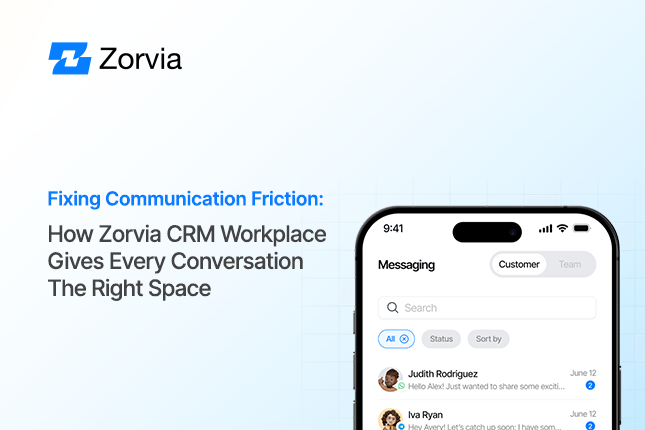
Fixing Communication Friction: How Zorvia Gives Every Customer Conversation the Right Place
Customer conversations don’t usually break down because a business doesn’t care.
They break down because messages come from too many places.
A customer sends a message on WhatsApp. Another sends a DM on Instagram. Someone else reaches out on Telegram. Your team moves between apps, switches accounts, scrolls through old conversations, and tries to remember who replied to whom.
Somewhere in the middle of all that, a message gets missed.
A customer waits too long.
A sale disappears.
This is communication friction.
It is the small, repeated effort that makes customer communication harder than it should be. The constant app-switching. The unread messages. The conversations that get buried. The customer relationship that exists in one employee’s personal account.
Most businesses do not call it communication friction. They just say they are busy.
But being busy should not mean losing track of your customers.
That is the problem Zorvia is built to solve.
The real problem isn’t that you have too many communication channels
WhatsApp, Instagram, and Telegram are useful because that is where your customers already are.
The problem starts when every channel becomes its own separate workplace.
Your team has to check one app for WhatsApp messages, another for Instagram DMs, and another for Telegram conversations.
There is no single view.
No simple way to see which messages have been handled.
During busy periods, conversations can easily get buried or forgotten.
The result is not just a communication problem.
It becomes a business problem.
You can spend money attracting customers and still lose potential sales because someone never replied.
That is why the goal should not be to force customers into one channel.
The goal should be to bring your customer conversations into one place.
The fix: One place for every customer conversation
Zorvia brings customer conversations from WhatsApp, Instagram, and Telegram into one shared inbox.
Instead of jumping between platforms, your team can manage conversations from one place.
This changes how communication works.
- Messages are easier to track.
- Teams have a clearer view of customer conversations.
- Fewer conversations get buried.
- Staff can work together without constantly switching between apps.
- Business owners have more control over how they manage customer relationships.
The goal is simple:
Every message, tracked. Every customer relationship, protected.
But bringing conversations together is only one part of the problem.
Because for many growing businesses, the bigger question is this:
How do you give your staff access to serve customers without giving away control of your customer relationships?
Communication friction gets worse when access and ownership become the same thing
For many businesses, delegating customer communication comes with a risk.
To let an employee respond to customers, the business may have to give that employee access to the customer’s phone number or social media account.
That means the person helping you manage the relationship may also have direct access to the relationship itself.
For a business owner, this creates an uncomfortable choice.
You can:
- Handle every customer conversation yourself and struggle to scale.
- Or give staff full access and hope that trust is never broken.
Neither option is ideal.
Growing your team should not mean losing control of the customers you worked hard to acquire.
This is where Zorvia takes a different approach.
Let your team serve customers without giving away the customer relationship
Zorvia is built around structural trust.
Your team can handle customer conversations without automatically gaining unrestricted access to the contact details behind those conversations.
The goal is not to make business owners suspicious of every employee.
It is to remove unnecessary risk from the way customer communication is managed.
Your staff should be able to do their jobs.
They should be able to respond, assist, follow up, and help close sales.
But your customer relationships should still belong to your business.
That is the difference between simply trusting a process and building protection into the process itself.
Stop switching between apps to keep up with customers
App-switching seems like a small problem until you do it all day.
Check WhatsApp.
Reply to an Instagram DM.
Open Telegram.
Go back to WhatsApp.
Try to remember which customer you were speaking to before the interruption.
Repeat.
This constant switching creates friction for sales teams, customer support teams, and business owners.
It also makes it harder to see the full picture.
When conversations are scattered across platforms, there is no simple answer to questions like:
- Has this customer already been helped?
- Did anyone reply to this message?
- Which conversations still need attention?
- Who on the team is handling this customer?
A unified inbox gives the team a shared space to manage the work.
Instead of managing platforms separately, you manage the conversations that matter to your business.
Give your team one place to work together
Customer communication should not depend on one person remembering where everything is.
When your team works from a shared inbox, conversations become easier to manage as a team.
A customer message doesn’t have to stay trapped in one employee’s phone.
The team can work from the same system while business owners maintain oversight of the customer relationships.
This reduces one of the biggest sources of communication friction: the gap between who received the message and who is responsible for responding.
Instead of wondering whether someone has handled a conversation, your team can manage it all in one place.
That means less guessing.
Less duplication.
And fewer customers falling through the cracks.
Work the way your business already works
Many business tools are built around a desktop-first way of working.
But that is not how many African businesses manage customer conversations.
For sales teams, customer support staff, social-commerce sellers, and business owners, the phone is often where the work happens.
That is why a communication system should fit into the way people already work.
Not force them to adopt an entirely different way of doing business.
Zorvia is designed with this reality in mind.
The goal is not to turn everyday business owners into CRM experts.
It is to make managing customer conversations simpler, safer, and easier to control.
Communication should move customers closer to a sale
A customer conversation is often part of the buying journey.
Someone asks about a product.
They want more information.
They are ready to pay.
Every unnecessary step between interest and payment creates another opportunity for the customer to drop off.
That is why communication should not exist separately from the rest of the customer experience.
Zorvia is built on the idea that conversations can move naturally toward action, including payments, without forcing customers through unnecessary steps or platforms.
The simpler the journey, the easier it is for a customer to move from:
Interested → Ready → Paid
Where most businesses go wrong
Communication problems are not always caused by the wrong tools.
Sometimes, they stem from how businesses manage access, conversations, and customer relationships.
Here are some common mistakes.
1. Keeping every platform separate
When you manage WhatsApp, Instagram, and Telegram independently, messages are easier to miss.
Your customers may not care which platform they used to contact you.
They simply expect a response.
2. Giving staff unrestricted access to customer relationships
Delegation should help your business grow.
It should not create a situation where the customer relationship leaves with the employee.
Your team needs enough access to do the work, but your business should still own the relationship.
3. Relying on personal accounts to manage business communication
When customer conversations live inside personal staff accounts, visibility and continuity become difficult.
If someone leaves, the business may lose more than an employee.
It may lose access to valuable customer relationships.
4. Letting messages get buried during busy periods
A missed message may look small.
But for a customer who is ready to buy, it can mean a lost sale.
When conversations are scattered, it becomes harder to see what still needs attention.
5. Staying small because growth feels risky
Some business owners hesitate to hire more people because giving someone access to customers feels like giving away too much control.
But you should not have to choose between growing your team and protecting your business.
You should be able to do both.
The Zorvia approach: Grow your team without losing your business
Zorvia is not just about putting multiple messaging channels into one inbox.
It is about making growth feel safer.
The idea is simple.
Bring your customer conversations together.
Give your team the tools to serve those customers.
Protect the relationships that keep your business growing.
That creates a better flow:
Customer message → Team response → Customer action
Without the constant switching, scattered conversations, and unnecessary exposure that can make delegation risky.
Wrapping up
Communication friction is expensive.
It costs time when your team switches between apps.
It costs sales when messages are missed.
And it can cost much more when growing your team means giving away control of your customer relationships.
The answer is not to communicate more.
It is to manage customer communication better.
With Zorvia, businesses can bring conversations from multiple channels into one place, give teams a shared way to manage customer communication, and protect the relationships that keep the business growing.
Because you should be able to grow your team without losing control.